
What is a CAT and how does it work? Everything you need to know about Authorized Treatment Centers
- Jul 30, 2025
- 4 min read

If you're looking for a reliable car part, you've probably heard of an Authorized Service Center (ATC), but few people really know what an Authorized Service Center is, how it works, and why it's so important when it comes to finding a part in good condition.
At Expart, we work exclusively with CAT suppliers because they are the only centers officially authorized for the treatment, dismantling, and reuse of vehicles. Today, we'll explain clearly and completely what happens inside a CAT and how it guarantees the quality of the spare parts that reach you.
What is a CAT?
A CAT (Authorized Treatment Center) is a facility legally recognized by the government to manage end-of-life vehicles. It's not just a scrapyard: a CAT is subject to strict technical and administrative regulations and must have qualified professionals, specific equipment, and controlled processes.
Only authorized centers like CAT can process the final deregistration of a vehicle, safely dismantle it, and offer used parts that meet legal requirements for sale.
In short, if a car has been properly deregistered, it has passed through a CAT (Central Inspection Service). If a used part is legal, it comes from a CAT (Central Inspection Service).
What happens inside a CAT? Step by step
Let's see what the actual process is like for a car from the moment it enters a CAT until its parts are ready to return to the market:
Reception and documentary verification of the vehicle
The vehicle is physically delivered to the CAT facilities by an individual, an insurer, or a company. At this point, the vehicle's documents are collected, ownership and legal status are verified, and the final deregistration process with the Directorate General of Traffic (DGT) begins.
This step is key because it ensures that the entire process is transparent, legal, and traceable from the very beginning.
Digital registration in the CAT system
Every vehicle entering a CAT is registered in its internal system, which manages all information about:
Make, model and exact engine
Enrollment and entry date
Mileage, if available
Visible state of the car
Relevant damages or previous incidents
This record not only serves legal purposes, but also allows for full traceability of any piece recovered later.
Technical evaluation of the vehicle
Before disassembling anything, specialized technicians perform a visual and technical assessment of the car's condition. This allows them to identify which parts could be recyclable and which ones could not.
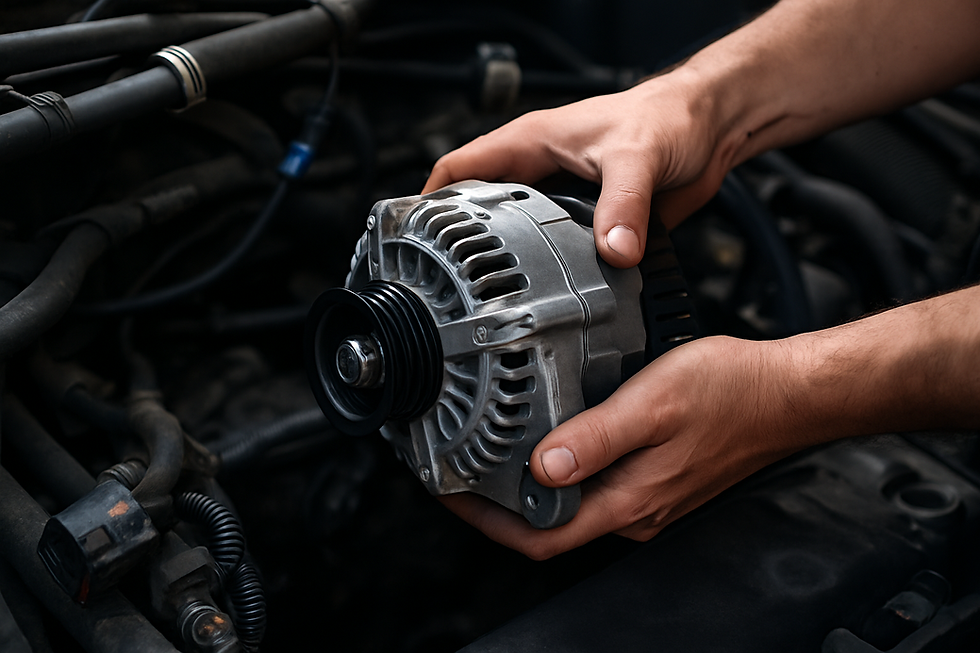
At this stage, we also assess whether there are any particularly valuable components that require priority removal due to demand, such as alternators, engines, gearboxes, or electronic control units.
Technical disassembly process
Once the potentially valid parts have been identified, disassembly begins.
This is not an improvised process, but it is done:
In delimited, clean areas and with specific tools
Following technical protocols to avoid damaging components
Recording each extracted part and digitally associating it with the vehicle from which it came
This ensures that each spare part can be traced back to its source, which is essential for the safety and confidence of the end customer.
Cleaning, verification and cataloging of parts
After disassembly, the parts go through:
Technical cleaning: removal of grease, dust, dirt or residue
Visual and functional review (when applicable)
Internal cataloging, where precise information is entered into the CAT database: part type, reference, compatibility, approximate mileage, aesthetic and mechanical condition
Only those parts that meet the CAT's internal quality criteria are considered usable. The rest are discarded.
Professional storage
Approved parts are stored under controlled conditions: metal shelving, coded identifiers, and rapid access via computerized systems. This allows for efficient stock management and accelerates response time when a client like Expart makes a specific request.
What warranty does a CAT replacement offer?
Even if they are used parts, spare parts from a CAT are legal and safe. Their origin is documented, they have been inspected by professionals, and they have the traceability required by law.
In many cases, these spare parts come with a minimum legal warranty, and at Expart, we also subject them to a second technical inspection to offer an even higher standard of reliability.
How does a CAT differ from a traditional scrapyard?
This is where the confusion arises the most. Many people think that all scrapyards are the same, but this is not the case. An unauthorized scrapyard may operate without complying with legal requirements, without qualified professionals or control processes. However:
Informal scrapping | Authorized CAT |
Without traceability | Complete vehicle registration |
Unchecked parts | Parts disassembled by technicians |
Risk of damaged or stolen parts | Traceability and document control |
No warranty | Legal compliance + minimum guarantees |
No environmental commitment | Processes regulated by official regulations |
That's why at Expart we only work with certified CATs. This is the only way to guarantee the quality of the spare parts and the safety of our customers.
Conclusion: CATs are the basis of the legal spare parts market
If you're thinking of buying a used part, make sure it comes from a CAT. This is your only guarantee that:
The piece is legal, safe and tested
It has a clear and documented origin
Has been treated by professionals under official regulations
At Expart, every time we receive a request, we contact our trusted CAT network to find the right part, check its condition, and only then ship it with our Expart Guarantee Seal.
Want to know if we have the part you need? Or are you interested in learning more about our supplier network? Write to us at info@expart.es.
We advise you step by step, as if it were for our own car.
Contact us:
Web: www.expart.es
Email: info@expart.es
Wallapop: Expart Profile


Comments