
Is my car worth repairing? A guide to deciding whether to fix or replace it
- Jul 30, 2025
- 6 min read

"My car is 15 years old and I have a €800 breakdown. Should I fix it or buy a new one?" is the question I get asked most often, and the answer isn't as simple as it seems.
I've seen people scrap cars that could have lasted five more years with a smart repair. And I've also seen others spend €3,000 to repair something that wasn't even worth €2,000.
The key isn't the age of the car, but knowing when a repair makes economic sense and when it's a waste of money.
After years of helping homeowners in this situation, I'm going to give you the exact criteria to make the right decision.
The "10-Year" Myth: Why Age Isn't the Most Important Thing
What really matters is not the age, but the general condition of the car:
A well-maintained 15-year-old car can be a better investment than a battered 8-year-old one.
Kilometers matter more than years (except for rubber parts)
Maintenance history is key
Make and model determine parts availability.
Real-life example : Customer with a 2010 BMW 3 Series (14 years old). Turbo failure: €750. The car was worth €8,000 and was in perfect condition. Decision : Repair. Result: 4 more years of trouble-free driving.
Cars that DO deserve repair after 10 years
Well-preserved premium brands :
BMW, Mercedes, Audi with up-to-date maintenance
High residual value and available parts
Superior build quality
Reliable cars with low mileage :
Toyota, Honda, Mazda with less than 150,000 km
Minimal breakdown history
Repair cost vs. break-even value
Special or unique vehicles :
Discontinued cars that you especially like
Models with sentimental value
Depreciated commercial vehicles
The mathematical formula to decide
50% Rule (Basic)
If the repair costs more than 50% of the car's value, it's usually not worth it.
But be careful : This rule has important exceptions that I will explain to you now.
Full analysis (recommended)
1. Real value of the car
Check current market prices
Discount wear and tear and possible defects
Consider the cost of searching for and purchasing another
2. Total cost of repair
Current budget + possible surprises (add 20%)
Includes parts that should be changed "as we are"
Labor and time without a car
3. Cost of changing cars
Purchase price of an equivalent one
Transfer, MOT, insurance
Possible repairs of the "new" (there are always some)
Time spent searching and managing
Practical example of analysis
Case : 2012 Ford Focus, 180,000 km. Failure: gearbox (€1,200)
Car value : €4,500 Repair cost : €1,200 + €200 extras = €1,400 Change cost : Equivalent car €6,000 + €300 paperwork = €6,300
Analysis : €1,400 vs €6,300 → Repair is €4,900 cheaper Decision : Repair clearly profitable
When it IS worth repairing
Repairs that add years of life
Engine and transmission in good general condition :
If only one specific part fails
The rest of the set is fine.
Correct prior maintenance
Isolated breakdown in a well-maintained car :
Up-to-date maintenance history
No other signs of deterioration
Reliable well-known brand
Much lower cost than change :
Repair less than 30% of the value
Parts available at a good price
Reasonable workmanship
Smart repairs for vintage cars
Bet on verified used original parts :
Original quality at a reasonable price
Availability of discontinued parts
Performance Guarantee
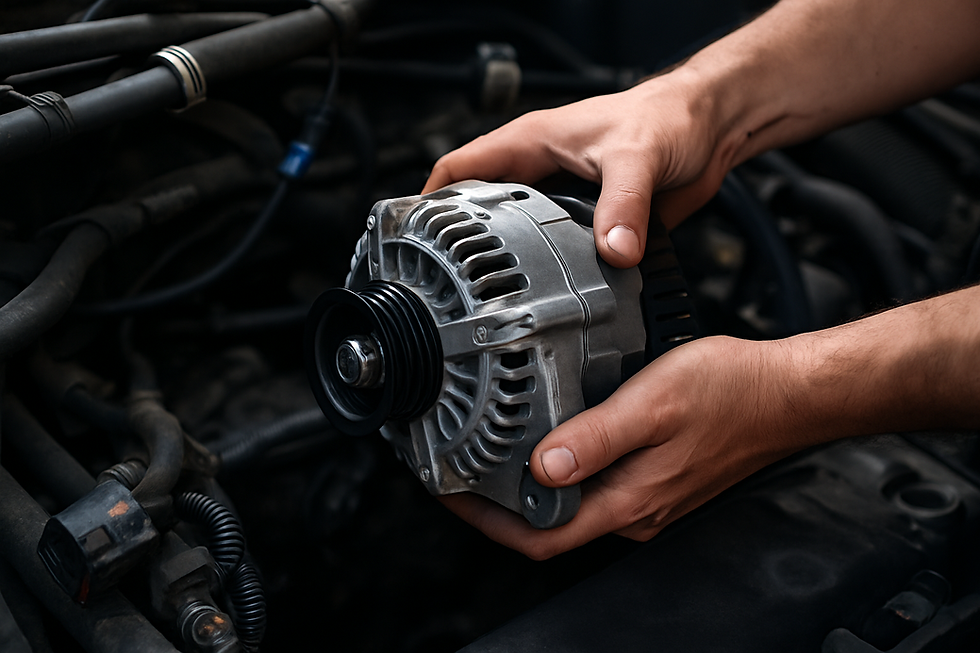
Example : Customer with a 2008 Volkswagen Passat. He needed an original alternator (new: €420, no longer manufactured). Expart solution : Original alternator inspected for €165. The car continued trouble-free for another 3 years.
When it is NOT worth repairing
Obvious warning signs
Cascading failures :
One repair immediately leads to another
Multiple systems failing at once
Cumulative cost skyrocketed
Battered car :
Non-existent maintenance for years
Multiple pending breakdowns
Structural rust or major damage
Disproportionate cost :
Repairs exceeding 70% of the value
Very expensive or hard-to-find pieces
Excessive time without a car
Typical cases where it is not worth it
High mileage low-end cars :
More than 200,000 km without maintenance
Very low residual value
Frequent expected breakdowns
Major structural repairs :
Blown engine in cars over 12 years old
Broken gearbox + other serious problems
Damage due to accident or negligence
Brands with very expensive parts :
Discontinued premium cars
Brands with limited service network
Models with unique specific parts
The emotional factor: when to ignore math
Cases where repair makes sense even if it is not profitable
Real sentimental value :
First car, family inheritance
Special model that you love
Car you know perfectly
Specific need covered :
Adapted commercial vehicle
Car for very specific use
Economic situation that does not allow change
But always with limits :
Maximum 80% of the value in "sentimental" repairs
Only if the rest of the car is healthy
With a closed budget, no surprises
Typical mistakes in decision making
Mistake #1: Comparing with a new car
Bad : "For €1,500 more I'll buy a new one." Good : Compare with equivalent second-hand cars.
A new car of a similar range can cost €20,000. The real comparison is with equivalent used cars.
Mistake #2: Not considering the hidden costs of change
Forgotten costs :
Transfer, MOT, insurance
First repairs of the "new"
Time spent searching and managing
Loss of awareness of the current car
Mistake #3: Repairing piecemeal without a global vision
Typical case : Troubleshooting faults one by one without evaluating the whole.
Better : Make a complete diagnosis and decide with all the information.
Smart strategies for older cars
The phased repair
Step 1 : Repair only what is essential for safety Step 2 : Evaluate performance for 6 months Step 3 : Decide on additional investments based on evolution
Choosing the Right Repairs
Priority 1 - Critical Safety :
Brakes, steering, tires
Basic suspension
Lights and signaling
Priority 2 - Basic reliability :
Engine and transmission
Essential electrical system
Refrigeration
Priority 3 - Comfort (only if everything else is okay) :
Air-conditioning
Comfort elements
Aesthetics
Advantages of Expart for vintage cars
Specialists in discontinued parts
What we offer :
Wide network of CATs with varied stock
Original parts for vintage models
Application-specific verification
Prices adapted to the value of the vehicle
Cases where we shine :
Parts that are no longer manufactured
Specific components of discontinued models
Original alternatives at reasonable prices
Honest advice
We don't sell for the sake of selling :
We tell you if it's worth it or not
We evaluate the whole, not just the piece
We prioritize according to your budget and needs
Practical decision guide
Ask yourself these questions
How much is my car really worth? (Be honest)
How much would an equivalent one cost? (Including paperwork)
Is this the only fault or is there more to it?
Have I taken good care of the car so far?
Is the financial effort worth it?
Simple decision matrix
Car value | Repair cost | Recommended decision |
Less than €3,000 | More than €1,500 | Probably change |
3,000€ - 6,000€ | Less than €2,000 | Evaluate case by case |
More than €6,000 | Less than €3,000 | Probably repair |
Note : Always considering that the rest of the car is in good condition.
My recommendation as an expert
Don't be afraid to repair a car that's more than 10 years old if :
You have been careful with maintenance
The fault is specific, not generalized
The cost is reasonable compared to the value
You find quality pieces at a good price
Yes, consider changing it if :
It has been several years without proper maintenance
Breakdowns occur constantly
The cost clearly outweighs the benefit
Your situation allows and requires change.
Conclusion
The age of a car is just a number. What matters is its condition, your prior care, and whether the repair makes economic sense.
A well-maintained 15-year-old car can give you 5 more years of reliable use. A battered 8-year-old can be a constant wreck.
The key is to be honest with yourself about the actual condition of your car and make rational, not emotional, decisions.
A verified part isn't just any part . And a well-informed decision can save you thousands of euros and years of trouble.
Are you unsure whether your car is worth repairing? Tell us the model, year, mileage, and the fault atinfo@expart.es . We'll give you our honest opinion, even if we don't buy anything from you.
This isn't just about repairs. It's about making smart decisions about your mobility.
At Expart, we've reused more than 150 parts, avoiding more than 1,200 kg of waste and reducing CO₂ emissions by up to 75%. Because reusing is more sustainable, smarter, and more economical.
Questions about car repairs? Contact us:
Web: www.expart.es
Email:info@expart.es
Personalized attention in less than 24 hours


Comments