
Warning signs: when your car is urgently asking for a replacement
- Jul 30, 2025
- 5 min read

Your car speaks to you. Not with words, but with signals. And the difference between listening to them in time or ignoring them can be the difference between a €200 repair and a €2,000 one.
After years of seeing cars in garages, I can assure you that 80% of serious breakdowns could have been avoided if the owner had paid attention to the early warning signs. Your car doesn't break down overnight; it's warning you.
Today I'm going to teach you how to "listen" to your car like an expert mechanic does.
Noises you should never ignore
The metallic squeal when braking
What does it mean? The brake pads are at their limit, and the wear indicator is touching the disc.
What happens if you ignore it? Metal-on-metal will ruin the records. Cost: from €80 for pads to €400 for discs and pads.
Immediate action: Stop driving and check your brakes. This is a critical safety issue.
The high-pitched whistling of the engine
What does it mean? The auxiliary belt is worn or tensioned incorrectly.
What happens if you ignore it? The belt can break, leaving you without power steering, alternator, or air conditioning.
Immediate action: Visually inspect the belt. If you see cracks or fraying, replace it immediately.
The knocking in the engine
What does it mean? It could range from insufficient oil to internal damage to the connecting rods or pistons.
What happens if you ignore it? A blown engine. Cost: between €3,000 and €8,000.
Immediate action: Stop the engine immediately and call a tow truck.
Smells that are signs of distress
Sweet burning smell
What does it mean? Coolant leaking into hot engine parts.
What happens if you ignore it? Engine overheating and possible cylinder head failure.
Immediate action: Check the coolant level. If it's low, look for leaks and don't drive until you fix them.
Smell of rotten eggs
What does it mean? The catalytic converter is malfunctioning or there are problems in the exhaust system.
What happens if you ignore it? Catalytic converter failure (cost: €800-€1,500) and possible engine damage.
Immediate action: Check the exhaust system and take the car to a shop.
Smell of burnt oil
What does it mean? Oil leaking onto the exhaust or engine.
What happens if you ignore it? Risk of fire and serious engine damage due to lack of lubrication.
Immediate action: Locate the leak and assess whether it is safe to drive.
Abnormal car behavior
Vibrations in the steering wheel
At low speed: Problems with the wheels (balancing, tires) When braking: Warped brake discs When driving: Problems with the transmission or driveshafts
True story: A customer ignored the vibrations for months. The result: he had to replace both driveshafts (€600) when he initially only needed to balance the wheels (€40).
Jerks when accelerating
What does it mean? Problems with the fuel system (filters, injectors, fuel pump) or ignition system (spark plugs, coils).
What happens if you ignore it? Excessive fuel consumption, loss of power, and possible engine damage.
Immediate action: Check air and fuel filters. If persists, perform electronic diagnostics.
Gradual loss of power
What does it mean? It could be a clogged particulate filter (FAP), a faulty turbo, or intake problems.
What happens if you ignore it? Cascading failures that can affect the engine, turbo, and exhaust system.
Immediate action: Take a high-revving highway trip to clean the DPF. If there's no improvement, go to a garage.
Visual signals that do not deceive
Lights on the instrument panel
Oil light (red): Stop immediately. Engine in danger. Temperature light (red): Stop and let it cool. Risk of overheating. Brake light (red): Check fluid level and parking brake. Check engine light (yellow): Engine problem. You can continue driving, but diagnostic work is required.
Abnormal exhaust fumes
Thick white smoke: Engine coolant leak (cylinder head gasket) Blue smoke: Oil burning (rings, valve guides) Black smoke: Rich mixture (injectors, air filter)
Your car's secret calendar
There are parts that fail due to time, not kilometers:
Every 4-5 years
Battery: First symptoms are slow cold starts
Cabin filter: Bad odor and reduced air conditioning efficiency
Brake fluid: Loses hygroscopic properties
Every 6-8 years
Shock absorbers: Gradual loss of stability
Silentblocks: Noises on potholes and loss of comfort
Rubber hoses: They harden and can burst
Every 10 years
Radiator: Internal leaks difficult to detect
Water pump: Progressive internal clearances
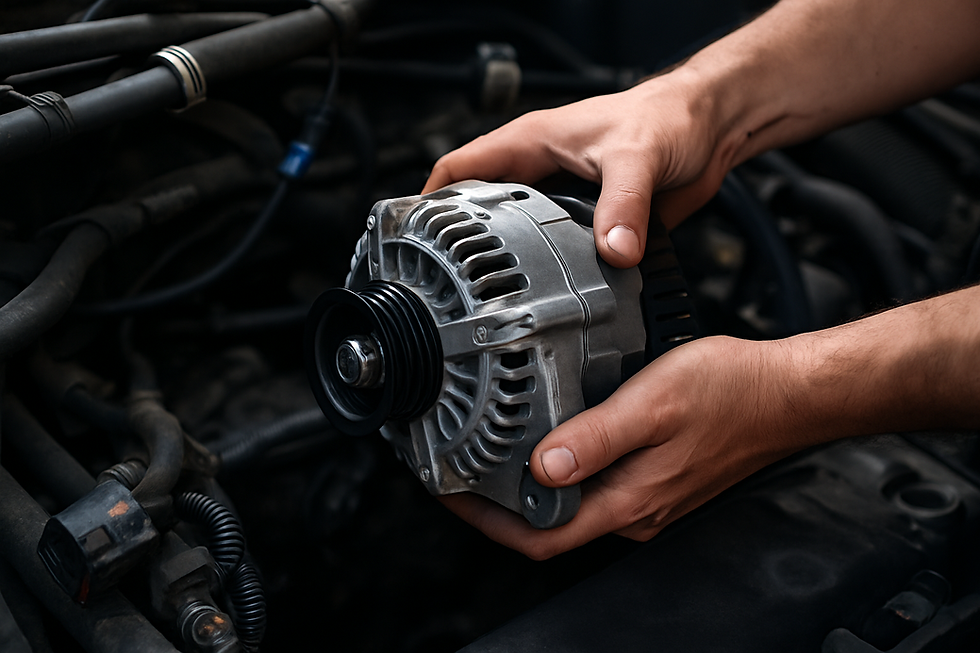
Alternator: Brush and bearing wear
How to do a basic preventive checkup
Weekly visual inspection (5 minutes)
Tires: Pressure and uneven wear
Fluids: Puddles under the car when parking
Lights: All operating functions
Windshield: Cracks that can spread
Monthly inspection (15 minutes)
Levels: Oil, coolant, brake fluid
Auxiliary belt: Cracks or fraying
Battery: Terminals clean and tight
Exhaust: Abnormal noises or smoke
Quarterly inspection (30 minutes)
Brakes: Visible pad thickness
Suspension: Rebound test on each wheel
Steering: Looseness and noise when turning
Air conditioning: Correct operation
Typical errors that aggravate breakdowns
Mistake #1 : "It's just a noise anyway."
Case study: A customer ignored a noise in the gearbox. Result: complete gear change (€3,500) when it was initially just oil (€150).
Mistake #2 : "I'd better wait for the next maintenance."
Real-life case: Brake pads squealing for two months. Result: ruined discs and damaged calipers (€800 vs. €120 initially).
Mistake #3 : "This isn't urgent"
Real case: Gradual loss of refrigerant ignored. Result: seized engine (€5,000) due to not changing a hose (€25).
The golden rule: act before it's too late
Investment vs. Expense: Replacing a part on time is an investment. Replacing it when it's already damaged is an expense.
Early vs. Late Signs:
Early: Light noise when braking → Change of pads (80€)
Late: Unresponsive brakes → Pads + discs + calipers (€600)
When is it time to look for an urgent replacement?
STOP signs (stop immediately)
Red oil light on
Thick white smoke from the exhaust
Loud metallic engine noises
Sudden loss of power
Brakes that do not respond correctly
Signs of urgency (maximum 1 week)
Continuous squealing when braking
Gradual loss of coolant
Strong vibrations in the steering
Flashing yellow lights
Warning signs (maximum 1 month)
Suspension noises
Slow loss of power
Excessive fuel consumption
Difficult starts
Why choose verified spare parts in urgent situations
When your car is urgently asking for a replacement, you don't have time for experiments:
Immediate availability: No waiting for manufacturing
Guaranteed compatibility: We verify that it is exactly what you need
Proven quality: Each piece passes our quality control
Installation without surprises: It works from the first moment
My final advice
After years in this industry, I can assure you that listening to your car is the best investment you can make. A timely replacement not only saves you money, it also saves you trouble, time, and stress.
Remember: a verified part isn't just any part. And a fault detected early can save you thousands of euros.
Is your car sending you signals you can't interpret? Don't hesitate to contact us at info@expart.es . We'll help you identify exactly what you need before it's too late.
At Expart, we've reused more than 150 parts, avoiding more than 1,200 kg of waste and reducing CO₂ emissions by up to 75%. Because reusing is more sustainable, smarter, and more economical.
Contact us:
Web: www.expart.es
Email: info@expart.es
Wallapop: Expart Profile


Comments