
When is it better to repair than replace? A guide to making the right decision
- Jul 30, 2025
- 4 min read

It's happened to you, hasn't it? You're in the shop and the mechanic says those words no one wants to hear: "This thing is broken." And then the moment of truth arrives: Should I repair it or replace the entire part?
It's one of the toughest decisions we face as car owners. And I'll be honest: there's no one-size-fits-all answer. But there are clear criteria that can help you decide without hurting your wallet too much.
The 50% rule that every mechanic knows
There's an unspoken rule in the world of mechanics: if the repair cost exceeds 50% of the value of the new part, it's best to replace it. But be careful, because this rule has its exceptions.
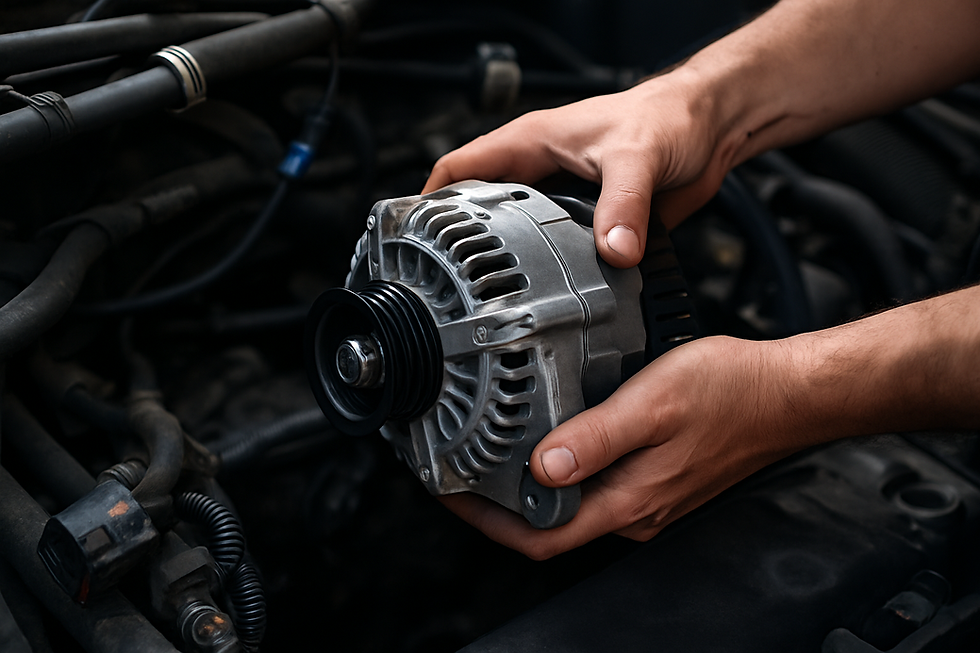
For example, if your alternator can be repaired for €80 but a new one costs €300, the repair makes sense. But if we're talking about a complex system like an automatic transmission, where a repair can cost €800 and a refurbished one €1,200, things change.
When repairing is the smart option
Simple mechanical systems
Alternators and starter motors: They usually have simple repairs (brushes, bearings, regulators)
Water pumps: If the problem is only the gasket, you don't need to replace the entire pump.
Brake systems: Pads, discs and cylinders are usually repairable before complete replacement.
Basic electrical components
Headlights and taillights: Many times it is only the bulb holder or the connector
Window regulator: The motor can be repaired in many cases
Air conditioning systems: Sometimes it's just a valve or a sensor
When change is the most sensible thing to do
Critical safety elements
There are no half measures here. If we talk about:
Airbags: Never repair, always replace
ABS Systems: Reliability is Key
Power steering: A failure can be dangerous
Parts with accelerated wear
Clutches: If the friction surfaces are damaged, replace them completely.
Shock absorbers: A temporary repair can compromise safety
Injection systems: Precision is key to performance
The time factor: what no one tells you
Repairs take time. And I'm not just talking about the time in the shop, but also the time your car will be idle waiting for diagnosis, specific parts for repair, and possible recurring faults.
A real-life example: One of our customers had a problem with his turbo. The repair cost €400 and required five days of work. A reconditioned turbo verified by Expart cost €650 and was installed in one morning. What did he choose? The complete turbo. The result: he was back on the road the same day, with a full warranty.
The "while we're at it" trap
It's the classic: "Since we're already working on this, let's take advantage of it to change that." Sometimes it makes sense, but other times it's an unnecessary sell.
When "since we're here" does make sense:
Change the brake pads when you change the discs
Replace the water pump when changing the timing belt
Replacing the silent blocks when changing the shock absorbers
When NOT:
Replace parts that are not working properly "just in case"
Replacing components that are not related to the current fault
Making "packages" that do not provide real value
How to evaluate the actual condition of a piece
Visual inspection
Corrosion: Is it superficial or does it affect the structure?
Wear: Are tolerances within limits?
Cracks: Are they repairable or do they compromise integrity?
Functional tests
Performance: Is it working at 100% or are there losses?
Abnormal noises: Do they indicate internal wear?
Behavior: Does he respond as he should?
The hidden cost of repairs
A cheap repair can be expensive if:
It breaks down again soon (double labor)
Damages other components by not functioning properly
Reduces overall vehicle reliability
That's why at Expart we always recommend: if you're going to repair it, do it right. If you can't do it right, it's better to replace it with a certified part.
Special cases: old vs. modern cars
Cars older than 15 years
New parts are becoming more expensive and harder to find.
Repairs are usually more cost-effective
Systems are simpler and more repairable
Modern cars (less than 10 years old)
The systems are more complex
Repairs require specific tools
It is often more cost effective to replace than to repair.
My recommendation as an expert
After years in this sector, my advice is clear: always prioritize safety and reliability over immediate savings.
If you have doubts, ask yourself these questions:
Is it a safety-critical component?
Will the repair give me the same reliability as a new or reconditioned part?
Is the total cost (repair + risk of failure) worth the replacement?
The smart alternative: verified original used spare parts
And this is where what we do at Expart comes in. You don't always have to choose between repairing or buying new. There's a third option: verified original used spare parts.
Lower cost than a new part
Greater reliability than a repair
Full performance guarantee
Sustainability for the environment
Every part we inspect goes through an exhaustive process where we verify not only that it works, but that it will continue to work reliably.
Conclusion
The decision between repairing or replacing a car isn't just a financial one; it's a strategic one. Consider the use you give your car, the importance of the part in question, and, above all, your peace of mind.
Remember: a verified part isn't just any part. And a well-made decision can save you trouble, time, and money in the future.
Do you have questions about a specific part? Don't hesitate to contact us at info@expart.es . We're here to help you make the best choice for your car.
At Expart, we've reused more than 150 parts, avoiding more than 1,200 kg of waste and reducing CO₂ emissions by up to 75%. Because reusing is more sustainable, smarter, and more economical.
Contact us:
Web: www.expart.es
Email: info@expart.es
Wallapop: Expart Profile


Comments